
The country's exports dipped 8.74 per cent to $23.52 billion in November on account of contraction in shipments of key sectors like petroleum, engineering, chemicals and gems and jewellery, official data showed on Tuesday. Trade deficit during the month narrowed to $9.87 billion as imports too declined by 13.32 per cent to $33.39 billion.

A sharp appreciation in rupee rate against dollar has left exporters worried since most of them get their exports invoiced in greenback

India's exports rose marginally to $27.15 billion in December 2020, while imports surged 7.56 per cent to $42.59 billion, official data showed on Friday. The merchandise exports were valued at $27.11 billion in December 2019 while imports had totalled $39.59 billion.

India's merchandise exports rose by 22.63 per cent year-on-year to $33.79 billion in September on better performance by key sectors like engineering goods and petroleum products, according to official data released on Thursday.

Domestic exporters may soon start shipments of mangoes, such as 'Dasheri' and 'Langda', to the US as America will start accepting testing certificates of specified agencies of India, a senior government official said on Tuesday. India has not exported mangoes to the US for the last two years. The set protocol involves the arrival of the US phytosanitary inspector, who monitors the process, which is called pre-clearance operations before exports. They have not visited India during the summer of 2020 and 2021.
The FIEO on Thursday reiterated that the Customs authorities at several ports in India had ordered a sudden examination of Chinese consignments without any official word from the government, and this may have led to the Chinese retribution.
Trade deficit marginally widened to $9.85 billion as against $9.72 billion in February 2019.

Export sectors that showed positive growth last month included chemical, iron ore, electronics, marine products and pharmaceuticals. Decline in overall imports, including oil and gold, led to narrowing of trade deficit.
Imports too tumbled by 58.65 per cent to $17.12 billion in April from $41.4 billion in the same month last year, according to the data by the commerce and industry ministry.
Sectors, which, recorded healthy export growth included electronics, engineering, chemicals, pharma and tea.
Imports too declined by 16.31 per cent to $37.39 billion.
The country's exports jumped by 58.23 per cent to $34 billion in March as key sectors such as engineering, gems and jewellery and pharmaceuticals recorded healthy growth rate during the month, according to the Commerce Ministry's provisional data. Exports during April-March 2020-21, however, dipped by 7.4 per cent to $290.18 billion compared to $313.36 billion in 2019-20, the data showed. Imports during 2020-21 contracted by 18 per cent to $388.92 billion compared to $474.71 billion during 2019-20. In March 2020, the exports stood at $21.49 billion, which was a decline of about 34 per cent over March 2019 due to global slowdown induced by the Covid-19 crisis.

The country's apex exporters body Federation of Indian Export Organisations said that support extended by the minister for research and development activities and reduction of duties on capital goods will help in increasing competitiveness of Indian products in the global market.
The country's exports grew by 47.19 per cent to $35.17 billion on account of healthy growth in the outbound shipments of petroleum, engineering, and gems and jewellery, according to the provisional data of the commerce ministry. Imports during the month also rose by 59.38 per cent to $46.40 billion, leaving a trade deficit of $11.23 billion. Exports of petroleum, engineering, and gems and jewellery in July increased to $3.82 billion, $2.82 billion and $1.95 billion respectively, the data showed.
Imports too contracted by 28.72 per cent to $31.16 billion. Dip in exports and imports narrowed the trade deficit -- the difference between imports and exports -- in March to $9.76 billion, the lowest in the last 13 months.

India's export basket for Pakistan has a limited portfolio as Pakistan has not given 'most favoured nation' status to New Delhi and such goods have ready market in South Asia and the Middle East.
The country's exports in December surged 37 per cent on an annual basis to $37.29 billion, the highest-ever monthly figure, government data showed on Monday.

Imports too declined 26 per cent to $29.47 billion in August, leaving a trade deficit of $6.77 billion.
Imports increased by 4.5 per cent, the highest growth in the last six months as crude oil and gold shipments shot up in the month.
India's exports dipped after a gap of four months in March but finished 2017-18 with a healthy rise of 9.78 per cent to $302.84 billion.

On the occasion of Chinese president Xi Jinping's two-day visit, Indian exporters are looking for a big boost in export of agricultural commodities, especially the ones that have been impacted by the ongoing trade war between the United States and China.
Out of 30 key export sectors, as many as 22 showed negative growth in September.
Imports rose by 1.44 per cent to $43.44 billion in March 2019.
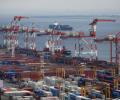
Barring rice, spices, iron ore and pharmaceuticals, all the remaining 26 key sectors registered negative growth in May. Imports too plunged 51 per cent to $22.2 billion in May.

The steep depreciation of rupee will not give an immediate advantage to the country's exporters.

Removal of this status means India can now enhance customs duties to any level on goods coming from Pakistan.

Sectors with positive growth during the month include rice, iron ore, oil seeds, oil meals, meat, dairy and poultry products, pharmaceuticals, coffee, engineering goods, and plastic.

Gold, a safe-haven bet, is likely to continue its record-smashing journey in the New Year, rising to Rs 85,000 per 10 grams and even Rs 90,000 level in domestic markets if geopolitical tensions and global economic uncertainties continue.

India has decided to authorise the country's biggest lender SBI to promote rupee trade with Russia and soon Moscow will name its bank to operationalise the mechanism, exporters' body FIEO said on Wednesday. The RBI in July issued a detailed circular asking banks to put in place additional arrangements for export and import transactions in Indian rupees in view of increasing interest of the global trading community in the domestic currency. Currently, a large part of bilateral trade between India and Russia is getting settled in rupee due to sanctions imposed by the US and Europe following Moscow's attack on Ukraine.
A combination of externalities such as global trade wars and slowing growth, continuing glitches in accessing offsets under the GST regime, which has created a liquidity crunch for smaller exporters, and the growing competitiveness of smaller countries are causing the slowdown.

Giving a relief to exporters community, the government on Thursday said it will release Rs 56,027 crore to exporters against pending tax refunds under different incentive schemes for outbound shipments. The amount will be disbursed to more than 45,000 exporters. Briefing the media about the decision, Commerce and Industry Minister Piyush Goyal said that the Rs 56,027 crore, which is being released under various export promotion schemes, is over and above duty remission of Rs 12,454 crore for the Remission of Duties and Taxes on Export Products (RoDTEP) Scheme and Rs 6,946 crore for Rebate of State and Central Levies and Taxes (RoSCTL) Scheme already announced.
Imports also fell for the eighth consecutive months, down 0.75 per cent to $41.14 billion in January, widening the trade deficit to a seven-month high of $15.17 billion.
The government has decided to postpone the release of the new Foreign Trade Policy (FTP) and extend the existing one by six months on account of global uncertainties and currency fluctuations. The government was scheduled to announce the new FTP by the end of September. The current policy was to end on September 30.

'If attacks escalate, there is a risk the Suez Canal may be closed.'

The rising dependence on discounted crude oil has resulted in India's trade deficit with Russia hitting the second-highest place last year, after China, reveals Department of Commerce data. From April through January 2022-23 (FY23), India's maximum trade deficit was with China, at $71.58 billion. This was followed by Russia, where the deficit expanded sevenfold - from $4.86 billion in April-January of 2021-22 (FY22) to $34.79 billion during the same period in FY23.

For the first time, Amul fresh milk will be available outside India, with the Gujarat Cooperative Milk Marketing Federation (GCMMF) launching four variants of milk in the US market within a week, to cater to Indian diaspora and Asian population. "We have been exporting dairy products for many decades. This is the first time we are launching fresh milk outside India," GCMMF MD Jayen Mehta told PTI. He said "the GCMMF has tied up with 108-year old cooperative organisation Michigan Milk Producers Association (MMPA) to launch fresh milk in the US market."
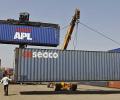
With exporters' claim for over five months still pending, liquidity has been wiped out and the process of finalising new contracts has been held up.

From toys, footwear and furniture to insulated flasks, smart meters, and air coolers - the Central government over the last decade has mandated higher standards for production and imports of such items. Sample this: Till 2014, there were 14 Quality Control Orders (QCOs) covering 106 products. By the latest count, there are 156 QCOs on 672 products.

RBI declines to accede to plea, upheld by Padmanabhan panel, for priority sector tag; feels move would dilute claims of those needing it more.
 © 2026 Rediff.com - Advertise with us - Disclaimer - Privacy Policy - Sitemap - Feedback - About us - Terms of use - Grievances